Food, Trade, and Travel Across the Kingdom
Food, Trade, and Travel Across the Kingdom
To understand Lavonshia, one must first understand how its people eat, trade, and move through the world. These everyday rhythms shape far more than comfort and survival—they define culture, class, and the invisible lines that separate one province from another.
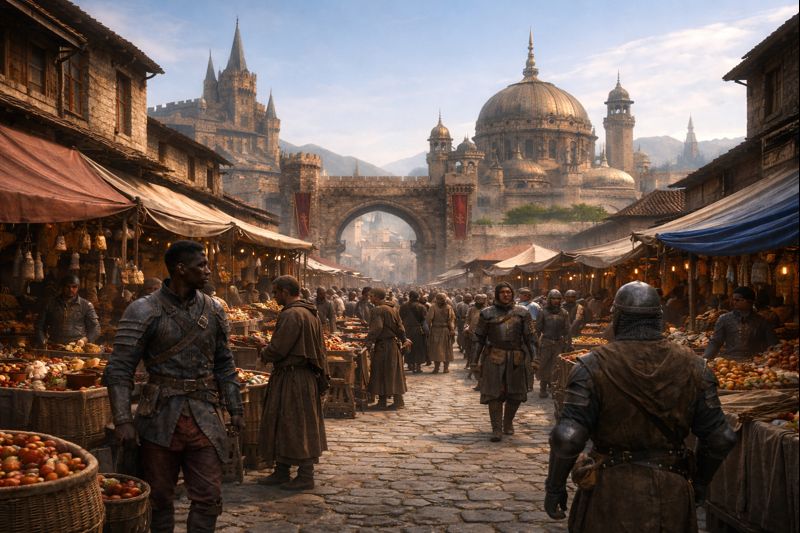
In the western reaches of the kingdom, especially near the Capitol, abundance gathers in sound and scent. Markets swell with voices and color, with merchants calling prices in decri and travelers following their noses rather than any map. Pies still warm from the oven, spiced buns glazed with honey, smoked sausages, rabbit skewers, and slow-roasted mutton fill the air. Food from the Plains arrives in steady supply, while more exotic flavors—salted fish from the Maldelea coast, sweets from the Twelve Isles, or silver-priced delicacies from Perinith—signal distance, wealth, and connection beyond Lavonshia’s borders.
Trade here is a performance as much as an exchange. Merchants hawk rugs from Perinith, lamps and bowls crafted by Plainsfolk, mountain lion furs from the Tol Mountains, and weaponry forged in the Highland smithies. Haggling is expected. Truth is flexible. A clever tongue can turn twenty-five decri into five, and even a simple dress can carry dreams of status, laughter, and fleeting escape.
East of the Capitol, beyond the Tol Mountains, the rhythm shifts. In Dorak and among the Gray Cloak lands, trade is still the standard. Goods are exchanged by need and agreement rather than coin, though decri is sometimes accepted—especially at taverns or inns that see more travelers than locals. Dorakian villages thrive on orchards, grains, and festivals that celebrate both harvest and survival. Here, food is shared communally, and plenty is measured not in excess but in assurance that no one goes hungry.
This contrast has not always been easy. The memory of famine lingers in quiet comments and hushed gratitude. Ashrot—the blight that once rotted crops from the inside out—forced the kingdom to reckon with scarcity, reshaping trade routes, swelling the ranks of the Ka, and leaving behind a wary respect for abundance that can vanish without warning.
Travel between these regions is slow, deliberate, and often unforgiving. Most journeys are made on foot, by wagon, or on horseback, following roads worn smooth by centuries of use. The Tol Mountains divide the kingdom in half, with Hadil’s Crossing offering the only reliable passage—and only for a narrow window each year. Rivers like the Narthwich serve as lifelines through forest and plain, while the Maldelea Sea defines Lavonshia’s northern edge, carrying ships toward the Twelve Isles or across open water to Perinith.
To travel is to feel the kingdom change beneath your feet. Accents shift. Coin loses value. Customs matter more than law. A traveler learns quickly where their decri is welcome, where it is unnecessary, and where it might even earn suspicion.
In Lavonshia, food tells you where you are. Trade tells you who holds power. And travel—slow, costly, and uncertain—reveals how far apart the kingdom’s many worlds truly are.
It is a land stitched together not just by roads and rivers, but by people trying to live, eat, and endure in the spaces between.